Why Even Top Tax Experts Avoid PFIC Work — And Tell Clients to “Just Sell It”
A candid, technical look at why PFIC work is a loss-making nightmare for firms — and what happens when clients cannot liquidate their PFIC funds
Published: Nov 2025
This article explains why experienced CPAs, EAs, and tax attorneys often recommend full disposition of PFIC holdings, why that advice is usually correct, why many PFIC-like funds (such as New Zealand KiwiSaver or Canadian mutual funds) cannot realistically be sold, and how the PFIC calculator on PFIC Calculator (pfic.xyz) is designed to support professionals with Sections 1291 and 1296 in those long-term, non-exitable cases.
1 — Why Even Top Experts Avoid PFIC Work
It is not an exaggeration to say that PFIC work is one of the least attractive assignments in international tax. Even highly experienced practitioners will quietly admit that they:
- Do everything they can to keep PFIC files out of their workflow;
- Prefer to advise clients to exit PFIC holdings entirely;
- And if they do accept PFIC work, they often lose money on the engagement.
This is not because they lack technical skill. On the contrary, the people who dislike PFIC the most are usually the ones who understand it best.
There are three core reasons:
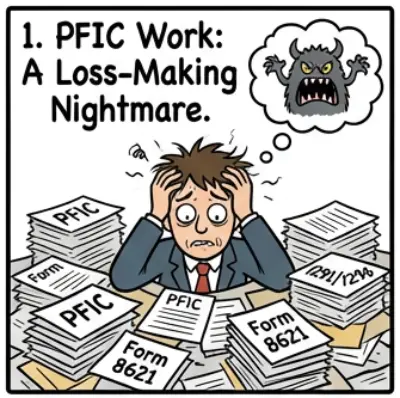
- Time cost — Sections 1291 and 1296 are structurally heavy. Multi-year dividend reinvestments, partial disposals, lot-level FIFO, and historic FX transformations turn even a “small” PFIC account into hours of cleaning and computation.
- Billing friction — The client often sees “just one form” and has no idea that the behind-the-scenes work rivals — or exceeds — a full expat return with multiple schedules.
- Audit risk — PFIC is highly documentation-sensitive. Without clear workpapers, the practitioner carries a disproportionate share of liability if challenged.
Combine those three and you get the unspoken consensus of many firms: “PFIC is a loss-making, high-risk engagement. Avoid it if you can.”
2 — Why “Just Sell It” Is Often the Best Advice
When a practitioner tells a client to sell the PFIC and take the pain once, that advice is usually:
- ✅ Mathematically sound;
- ✅ Risk-reducing over the long term;
- ✅ The most cost-effective approach for both the client and the firm.
A full disposition:
- Terminates the historical Section 1291 chain of excess distributions;
- Allows a one-time, well-documented Form 8621 computation;
- Dramatically simplifies future filing obligations;
- And is far easier to model than ten or fifteen years of annual PFIC reporting — see exactly how Dividends & Partial Sales Explode PFIC Complexity.

The PFIC §1291 technical article on PFIC Calculator (pfic.xyz) goes into the mechanics in detail: per-block calculations, income-only averages, original-currency excess determination, historic top rates, and §6621 interest. All of that logic must be applied whenever a PFIC disposition triggers default taxation under §1291(a)(2).
Once the PFIC is fully disposed and the resulting gain is processed under §1291, the ongoing burden disappears. From a professional standpoint, recommending full disposition is often the most responsible and scientific path.
3 — When PFICs Cannot Be Sold (KiwiSaver, Canadian Funds, Pensions, Global Platforms)
The real nightmare begins when the taxpayer cannot sell the PFIC — not because they don’t want to, but because the structure is legally locked, platform-restricted, or economically punitive to exit. In these cases, PFIC exposure is structural, not elective.
Around the world, many pooled investment structures are frequently PFIC-classified for U.S. persons and are not practically exitable in the way a normal brokerage fund would be. Common examples include:
-
New Zealand — KiwiSaver retirement schemes
KiwiSaver funds often invest through local pooled vehicles that are PFICs under U.S. rules. Statutory lock-in (retirement age, first home, hardship) means U.S. persons generally cannot liquidate simply to avoid PFIC taxation.

-
Canada — mutual funds inside TFSAs and non-registered accounts
Canadian mutual fund trusts and corporations are classic PFIC candidates. Many investors are restricted to a provider’s fund lineup and cannot exit without abandoning the tax wrapper or triggering frictional consequences. -
Australia — superannuation funds investing in unit trusts
Superannuation platforms are locked until retirement or very limited early-access events. Underlying managed funds often fall into PFIC territory, but members cannot unwind those holdings even if PFIC reporting becomes burdensome. -
United Kingdom & Europe — ISAs, workplace pensions, UCITS/OEIC platforms
UCITS, OEICs, and EU retail funds are typically PFICs for U.S. persons. When held inside ISAs or employer pensions, investors lack meaningful control to switch into U.S.-reporting products. -
Hong Kong & Asia — compulsory provident and occupational schemes
Structures such as Hong Kong MPF invest via PFIC-like pooled funds. They are mandatory, tightly locked, and cannot be liquidated at will. -
Insurance wrappers & portfolio bonds
Many life-insurance investment products and portfolio bonds are built on PFIC-classified funds. Early surrender typically triggers severe charges or local tax penalties, making exit economically unrealistic. -
Employer-mandated pensions & closed architecture platforms
Participants are often restricted to a fixed menu of house funds — many of which are PFICs — with no freedom to move into U.S.-compliant vehicles.
In all of these situations, there is no genuine “sell” button. The PFIC is embedded in the country’s retirement framework, not sitting in a normal brokerage account.
What This Means for Practitioners
- Form 8621 becomes annual and permanent — not a one-time clean-up.
- Every year’s numbers depend on prior-year distributions, reinvestments, MTM adjustments, and basis history.
- Small, recurring changes compound into a multi-year, lot-level, FX-dependent data chain.
- There is audit risk because regulators can trace PFIC errors across multiple years.
How It Feels in the Real World
From the client side:
From the practitioner side:
This is why so many experienced professionals tell clients to “just sell it” — not because they don’t understand PFICs, but because in locked systems, selling isn’t even possible. PFIC becomes a lifetime reporting obligation, not a transaction.
4 — Why PFIC Filing Is So Expensive (From the Firm’s Perspective)
For firms, PFIC is expensive not because of the form, but because of the work behind the form. Especially when there are:
- Dividend reinvestments — every reinvestment creates a new lot, with its own basis and holding period;
- Partial dispositions — requiring strict FIFO matching across lots and years;
- Multi-year excess-distribution testing — running the 125% rule and base-period logic for each relevant period;
- Historic FX — computing in original currency first, then translating into USD in the correct order;
- §6621 interest — applying quarterly rates and daily compounding for each prior-year allocation.
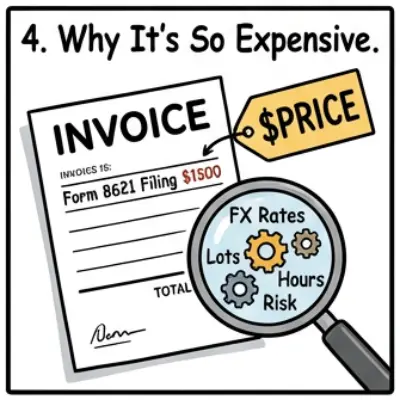
Even with a carefully designed Excel model, the firm faces:
- Data entry and cleaning time — messy broker reports, missing FX, non-standard transaction codes;
- Formula fragility — a single broken cell reference can silently invalidate the entire schedule;
- Review overhead — senior staff must manually verify that the engine still follows the statute and instructions;
- Client resistance to fees — “It’s just one form. Why does it cost this much?”
The result is often the same pattern:
- Preparation time is under-billed or written down;
- Review time is not fully captured in the invoice;
- The engagement ends up being loss-making with added liability.
This is why, from the firm’s perspective, PFIC can feel like a “permanent nightmare” in any file involving annual reinvestments or partial disposals.
5 — The Very Narrow Role of Excel in PFIC MTM
Sometimes practitioners assume that electing mark-to-market (MTM) under §1296 will make PFIC simple and “Excel-friendly”. Reality is more nuanced.
There is exactly one scenario where a skilled professional can reasonably rely on Excel for MTM workpapers:
- No dispositions during the year;
- Clean, reliable FMV data at each year-end;
- Consistent currency treatment and clear basis history.
The article How to Calculate PFIC MTM (§1296) in Excel — A Batch-Level Engine Guide and Common Errors to Avoid on PFIC Calculator (pfic.xyz) walks through how to build a compliant batch-level engine in that narrow context.
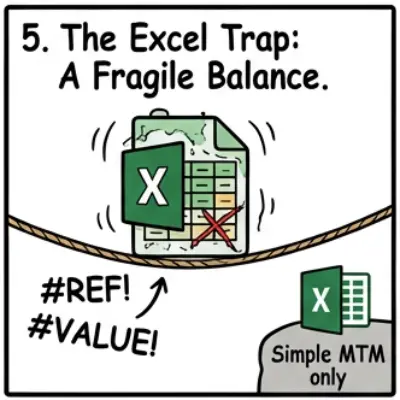
But once you add:
- Partial sales,
- Multiple entry points,
- Rolling carryforwards,
- Interactions with prior §1291 periods,
the spreadsheet quickly stops being robust. MTM is often easier than §1291 — but it is still a multi-year rolling system, not a one-line “FMV minus FMV” shortcut.
6 — Where PFIC Calculator (pfic.xyz) Fits: Built for Professionals, Not Consumers
The PFIC Calculator (pfic.xyz) calculator was built specifically for tax professionals who must handle PFICs that cannot be simply sold and must be reported year after year.
It is intentionally:
- Focused — supports Section 1291 default taxation and Section 1296 MTM; it does not attempt to handle corporate spin-offs, complex M&A basis events, or exotic restructurings.
- Transparent — produces large, detailed Excel workpapers rather than a single black-box number.
- Honest about scale — for long-term, monthly-reinvestment PFICs with partial dispositions and excess distributions, the engine may run for ten minutes and generate tens of thousands of rows of workpapers. That is a feature, not a flaw.
In other words, PFIC Calculator (pfic.xyz) is not about “instant answers.” It is about:
- Standardizing complex PFIC workflows;
- Preserving the full audit trail for Form 8621;
- Making PFIC work billable, repeatable, and defensible again.
Combined with the deep technical references like PFIC §1291 Calculation Explained — The Hidden Mechanics Behind Form 8621 Line 16a and the PFIC MTM Excel guide, the calculator is designed as a toolkit for professionals, not a consumer gadget.
📥 Downloadable Form 8621 Workpapers Samples (1291 & 1296)
To understand what a real, audit-ready PFIC engagement looks like when processed through the PFIC Calculator (pfic.xyz) engine, you can download two anonymized, fully-structured workpapers samples below. These are not hypothetical examples — they reflect the actual reporting formats used to support Form 8621.
Case A — Section 1291 Form 8621 Workpapers Sample
This sample illustrates the default-taxation regime under §1291 and shows what a professional, audit-defensible Line 16a package looks like in practice. The file contains three core tabs:
- 16a_Summary — filing-year overview, Line 15/16 totals, ignored transactions, current holdings, and cost-adjustment logs.
- 16a_Excess_Distribution — Form 8621 Part V Lines 15a–16f, organized by block and tax year, including lot-level Line 15b history.
- 16a_Disposition — gain treated as §1291 excess, showing Lines 15f–16f tied directly to FIFO lot matching.
Case B — Section 1296 MTM Workpapers Sample
This sample reflects the structure of a §1296 Mark-to-Market engagement. It includes:
- FMV Years — year-end FMV values by tax year, FX rates, and USD conversions.
- Multi-Year MTM Carryforward Table — opening units, year-end FMV, adjusted basis (EOY), and unreversed inclusions.
- Current-Year MTM Calculations — basis consumption, realized gain (13c), year-end FMV (10a), MTM gain/loss (10c), and allowed loss (Line 12).
These samples reflect the internal structures used by the PFIC Calculator (pfic.xyz) engine and are provided for study, reviewer training, and audit-preparedness purposes.
Summary
When tax professionals tell clients to “just sell the PFIC”, they are not being evasive or unhelpful. In many cases, full disposition is mathematically cleaner, risk-lowering, and far more efficient than living with a PFIC for another decade.
But when PFIC holdings cannot be liquidated — as with many pensions, KiwiSaver-type funds, and local mutual fund structures — PFIC becomes a permanent part of the client’s life and the firm’s workflow. At that point, the real question is no longer:
“Why is PFIC so expensive?”
but:
“How can we handle PFIC in a way that is accurate, audit-ready, and still economically rational for the firm?”
The combination of technical guidance and the PFIC Calculator (pfic.xyz) engine aims to answer that question. It does not make PFIC easy — but it makes PFIC possible to manage.